





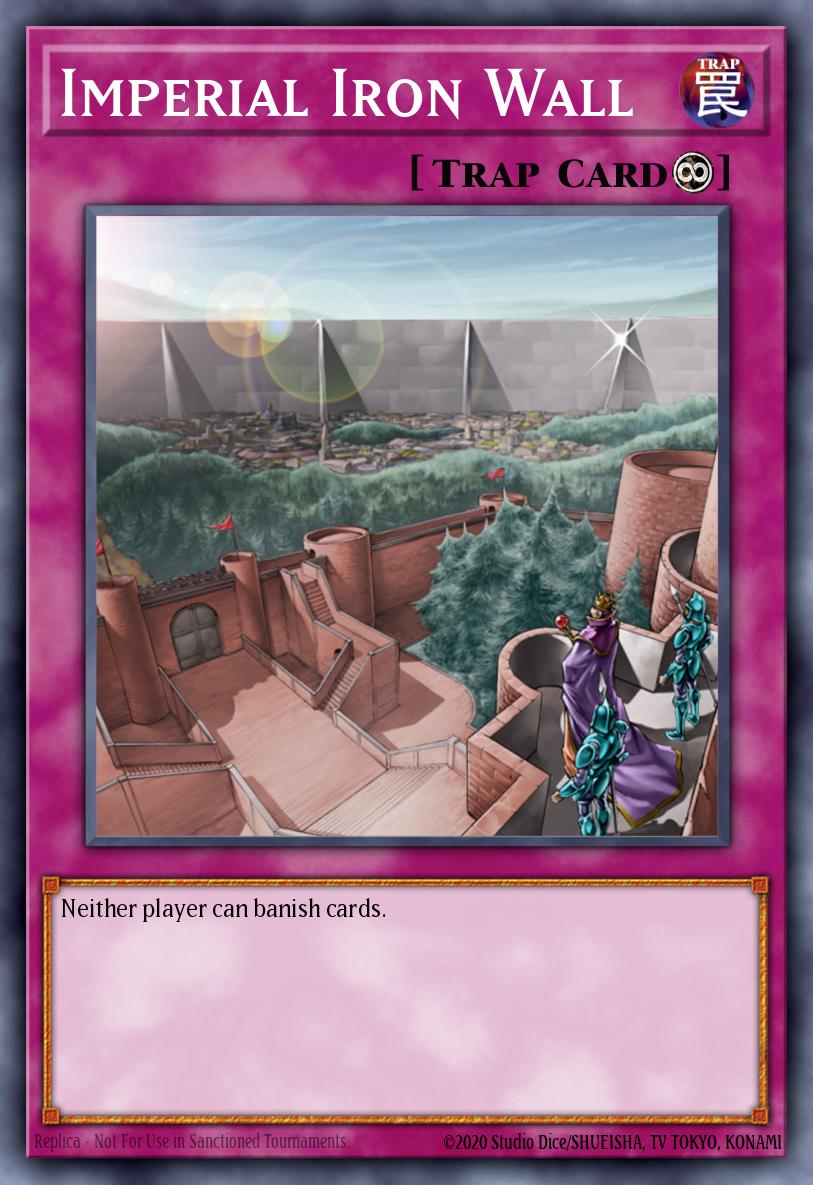

 Trap
 Continuous
Imperial Iron Wall
View:
6186
Neither player can banish cards.
Imperial Iron Wall — Power Evaluation
Final Score: 56 ± 8 · Confidence: Medium
- Intrinsic: 56 · Deck: 56 · Meta: provisional
- Primary role: Floodgate/Control
Why it scores here
Imperial Iron Wall converts almost nothing into board or card advantage on its own; its value is a symmetric floodgate that stops banish costs and banish effects for both players, which makes it a real interaction piece against banish-dependent lines. Its breadth across 121 archetypes in the 400-deck sample supports portability, but under guardrail 3 that frequency only confirms accessibility, not power. The score sits in the mid-range because the effect is narrow (banish only), it also restricts the owner's own banish lines, and no combo or ruling data is supplied to show it converting into wins.
Axis scores
| Axis | Score | Evidence |
|---|---|---|
| Accessibility | 55 | Set Continuous Trap present in all 400 sampled decks at an average of 1.82 copies across 121 archetypes, with no searcher or combo route evidenced (observed). |
| Combo & Conversion | 10 | Text is a single restriction with no board-building effect and combo data has zero appearances (verified text; observed absence). |
| Resource Economy | 40 | No draw, search or refuel; it trades one card for a lock that only matters against banish lines, so roughly neutral at best (inferred). |
| Effect & Interaction | 60 | Blocks all banish costs and effects for both players, a hard-to-play-around floodgate against banish-based lines but narrow in scope (verified text; inferred strength). |
| Material Utility | 5 | A Trap card with no material or level role (verified frame type). |
| Resilience & Flexibility | 40 | Sits on the field as a continuous card and its text gives no protection from destruction; redundancy comes only from 1 to 3 copies (inferred). |
| Deck-Building Efficiency | 65 | Generic single-slot trap with no garnet, locks itself out only of banish lines and is cheap to run at 1 to 3 copies (observed copy distribution; inferred cost). |
Calculation
Weight profile: Floodgate / Control primary; no secondary role. Intrinsic ≈ 56, Deck ≈ 56, Meta = provisional. Modifiers: Self-locking restriction (-2). Final formula: 0.40*Intrinsic + 0.60*Deck (decks present, combos absent, meta unknown)
Strengths
- Hard-to-play-around floodgate against banish-cost lines
- Generic, symmetric text that fits across 121 sampled archetypes
- Cheap, single-slot run at 1 to 3 copies
Weaknesses
- Only answers banish-based play; no effect against other mechanics
- Restricts the owner's own banish lines
- No board, draw or refuel contribution
Best use
Floodgate/Control against banish-cost lines. Decks: Apophis, Temple of the Kings, Blue-Eyes. Suggested copies: 2.
Evidence & gaps
- Verified: Card text: 'Neither player can banish cards.'; Formats: TCG, OCG, MasterDuel; Sample: 400 decks, 121 distinct archetypes, copies distribution 1 to 3 copies
- Observed: Present in 400 of 400 sampled decks, avg 1.82 copies; Gameplay type 7 in 82.8% of sampled decks; Top partners include Ash Blossom & Joyous Spring (66.5%) and Called by the Grave (55.2%); Guides 339 and 326 feature the card in counter sections ('Cách khắc chế')
- Inferred: Blocks banish-cost lines for both players, so it is strongest against banish-dependent engines and a mild self-restriction; Floodgate role rather than removal or negation, since it stops a mechanic and does not target cards
- Data gaps: No combos supplied: combo conversion is text-only inference No banlist token: assumed 3 copies (unlimited) No usage statistics (StatisticsCard); archetype inclusion inferred from the deck sample only decks running it in the Main Deck equals total decks (400), so the sample looks card-matched and may overstate presence rate No ruling or interaction data for destruction of continuous traps